






A destination wedding in Greece is not simply about breathtaking views in Santorini, charming chapels in the Cyclades, or romantic seaside venues in Crete. It is about embracing centuries-old customs that transform a beautiful ceremony into a meaningful cultural experience. Greek weddings are rich in symbolism, heartfelt rituals, music, laughter, and community, a true celebration of love shared not only between two people, but among families and friends.
Choosing to incorporate authentic Greek traditions into your destination wedding adds depth, emotion, and unforgettable character to your special day. It allows you and your guests to experience something far beyond the ordinary, a wedding infused with history, faith, joy, and vibrant Mediterranean spirit.

Greek wedding traditions are a harmonious blend of sacred ceremony and joyful celebration. Each ritual carries profound symbolism, reflecting unity, prosperity, devotion, and the promise of a shared future.
What makes Greek weddings truly extraordinary is their balance between reverence and festivity. They honor the sacredness of marriage while celebrating love with passion, laughter, and unforgettable energy.
Incorporating some of the Greek authentic customs into your destination wedding in Greece allows you to create more than just a picturesque event. You create a living experience — one where ancient ritual meets modern romance, and where every gesture carries a story.

Greek Wedding Customs
1. The Bridal Bed: Some days before the wedding, relatives and friends of the couple gather at their house and make the bed with white sheets, the young children or babied are placed on the bed as a sign of fertility.
The bed is made again a second time for attendees to throw money in combination with rice and sugared almonds called kufeta in Greek, thus symbolizing prosperity, good life and happiness.
The third time comes as the couple gathers the money, rice and koufeta off the bed. In some areas, the bridal bed is made by the groom all three times, which means that all setbacks and problems will be solved in the life of the couple.
2. Shaving the Groom: One of the wedding customs in Greece is the shaving of the groom right before the wedding. Throughout the preparation, his friends gather at the groom’s house to shave him and dress him for church.
3. The Bridal Shoes: Among the many enchanting traditions that make a Greek destination wedding so unforgettable, the ritual of the bridal shoes stands out as one of the most charming and lighthearted moments of the day. While the groom prepares for the ceremony, laughter fills the bride’s home as his friends and best man arrive with a special “mission” — to help the bride put on her shoes.
Of course, it’s all part of the fun. The bride playfully insists that the shoes don’t fit, pretending they are far too big for her delicate feet. Refusing to give up, the groom’s friends begin filling the shoes with money, symbolically wishing her prosperity, happiness, and a life filled with abundance alongside her future husband. In the end, it is the bride’s father who tenderly helps her slip into the “right” shoe, a touching gesture that symbolizes his loving support as she steps into this new chapter of her life.
But the magic of the bridal shoes doesn’t end there. Before leaving for the ceremony, the bride secretly writes the names of her single friends on the soles of her shoes. As she walks, dances, and celebrates throughout the day, some names gradually fade away. Tradition says that the girls whose names disappear first will be the next to marry, a romantic promise whispered with every step.
Do you see now how meaningful bridal shoes are in a Greek wedding? They are more than just an accessory; they carry blessings, laughter, love, and a touch of destiny. So, when planning your dream wedding in Greece, choose a pair that is not only elegant and chic, but worthy of walking you into a lifetime of happiness.
4. The premarital in Crete: Pre-marriage is one of the wedding customs in Crete and is still preserved as an institution. Friends and relatives of the couple gather and in a big feast they celebrate the wedding a few days before. Of course there is always live music, lots of food and plenty of wine.
5. The Dowry: In earlier times, ensuring the prosperity and financial independence of a newlywed couple was a primary concern for their families. The parents of the bride, eager to secure a comfortable and prosperous future for the couple, would discuss, negotiate, and agree on the dowry with the parents of the groom, before the wedding.
Traditionally, a dowry might include a house, land, money, or even livestock. The bride’s dowry chest also held exquisite handmade items, such as linen, carpets and fine embroideries, which the bride would display in her home for visitors to admire. Though this tradition today has faded, most of brides still have their dowry chest from their great – grandmother, grandmother and mother, passing them down to their own daughters one day!
6. The Groom’s arrival at the church: In the past and in several Greek locations today, inclusive of Crete, the Cycladic islands, Ionian islands, Epirus region and several others, the groom makes his way to the church accompanied by local musicians playing traditional musical instruments. Along with the groom and musicians, walks the family and friends of the groom.

7. The Bride’s Fashionably Late Arrival: In Greece, a bride never rushes to her own wedding. Quite the opposite, her arrival is meant to be anticipated. No matter the setting or the style of your destination celebration, this playful custom remains beautifully alive.
Whether she arrives by horse carriage through the cobbled lanes of the Saronic Islands, by traditional wooden boat along the shores of Crete and the Cyclades, on horseback in the rugged landscapes of Mani, or in a luxury car under the caldera views of Santorini, Athens, or Mykonos — one thing is certain: the bride must be fashionably late.
Tradition calls for her to arrive slightly after the groom, keeping him waiting at the church doors in sweet suspense. In many regions, she will even pass in front of the church three times before finally stepping out of the car or carriage. This symbolic gesture builds anticipation and adds a theatrical touch to the moment. It’s a charming ritual that heightens emotion, invites smiles, and makes her grand entrance all the more unforgettable.
The delay isn’t about hesitation — it’s about celebration. It’s the bride’s moment to be admired, to be awaited, to make an entrance worthy of the love story about to unfold.
8. The Joyful Sound of Wedding Horns: And how does everyone know a wedding is about to begin? In true Greek style — with noise, excitement, and unapologetic joy. As the bride and groom make their way to the church, friends and family follow in a lively procession of cars, honking their horns enthusiastically. The joyful “bipping” echoes through village streets, island harbors, and city avenues alike. It’s impossible to miss.
This beloved tradition announces to the entire neighborhood that a wedding is taking place. Strangers smile from balconies, café guests pause mid-conversation, and passersby turn to watch the celebration roll by. The sound of car horns becomes a proclamation of happiness — a public declaration that love is being celebrated. In Greece, weddings are never quiet affairs. They are shared, vibrant, and gloriously heard.
9. The Wedding Crowns – A Symbol of Unity: One of the most sacred and visually striking moments in a Greek wedding is the crowning ceremony. The priest places the stefana, delicate wedding crowns joined together by a ribbon, on the heads of the bride and groom. These crowns symbolize their union as king and queen of their new household and the spiritual bond that now connects them as one. The ribbon linking the crowns represents unity — two individuals joined together in faith, love, and shared destiny.
During the ceremony, the priest exchanges the crowns between the couple three times, sealing their commitment before God. Long after the vows have been spoken and the celebration has ended, many Greek couples preserve their stefana as treasured keepsakes. You will often find them displayed above the marital bed or in the living room, a daily reminder of the sacred promises made on their wedding day.

10. The Common Cup – Sharing Life as One: Another deeply symbolic moment is the sharing of the Common Cup. The bride and groom each drink from it three times, signifying that from this moment forward they will share everything in life, joy and sorrow, abundance and challenge, success and sacrifice. Nothing is meant to belong to only one of them anymore; their journey is shared in every sense.
Tradition adds a charming detail: whatever wine remains in the cup at the end of the ritual must be finished by the koumbaros or koumbara — the best man or best woman — the spiritual sponsor of the marriage. This gesture highlights their important role in guiding and supporting the couple throughout their married life.
11. The Dance of Isaiah – The Ceremonial Walk: Immediately after the crowning and the Common Cup comes one of the most beautiful and joyful moments of the ceremony, the Dance of Isaiah. Guided by the priest and followed by the koumbaros or koumbara, the couple walks around the altar three times.
This ceremonial walk symbolizes their first steps together as husband and wife. The circular movement represents eternity, a marriage without beginning or end. The priest leads the way, signifying that faith will guide their path, while the sponsor stands close, symbolizing lifelong support. It is not a dance in the festive sense, but rather a sacred procession, calm, graceful, and deeply meaningful.
12. The Rice – A Shower of Prosperity: As the newlyweds exit the church, laughter and cheers fill the air, followed by a joyful shower of rice. Guests toss handfuls of rice over the couple as a wish for prosperity, fertility, and a life rooted in abundance. Rice, as a seed that multiplies, symbolizes growth and flourishing.
By showering the bride and groom, family and friends are blessing their union with hopes for a fruitful and harmonious life together. It is a lively, photogenic moment — spontaneous, radiant, and full of excitement, marking the couple’s first steps into married life surrounded by celebration.
13. The Bobonieres – Sweet Symbols of Marriage: Like many cultures around the world, Greece embraces the tradition of wedding favors, but with its own meaningful twist. Known as bobonieres, these delicate satin or tulle pouches (or elegant little boxes) are filled with sugar-coated almonds, called koufeta. Their origins trace back to early Christian customs, when newlyweds would eat honey-coated almonds after the ceremony as a symbol of sweetness in marriage. Each element carries symbolism:
· The hard almond represents the endurance and strength of marriage.
· The sweet sugar coating symbolizes the sweetness of shared life.
· The egg shape stands for fertility and new beginnings.
· The white color reflects purity.
The almonds are always given in an odd number, indivisible by two, just like the couple, who are now united and inseparable. In earlier times, the priest would place almonds in the groom’s pockets after the ceremony, and he would offer them to unmarried women. Legend had it that if a single woman placed the almonds under her pillow, she would dream of her future husband.
A simple sweet — yet layered with centuries of meaning.
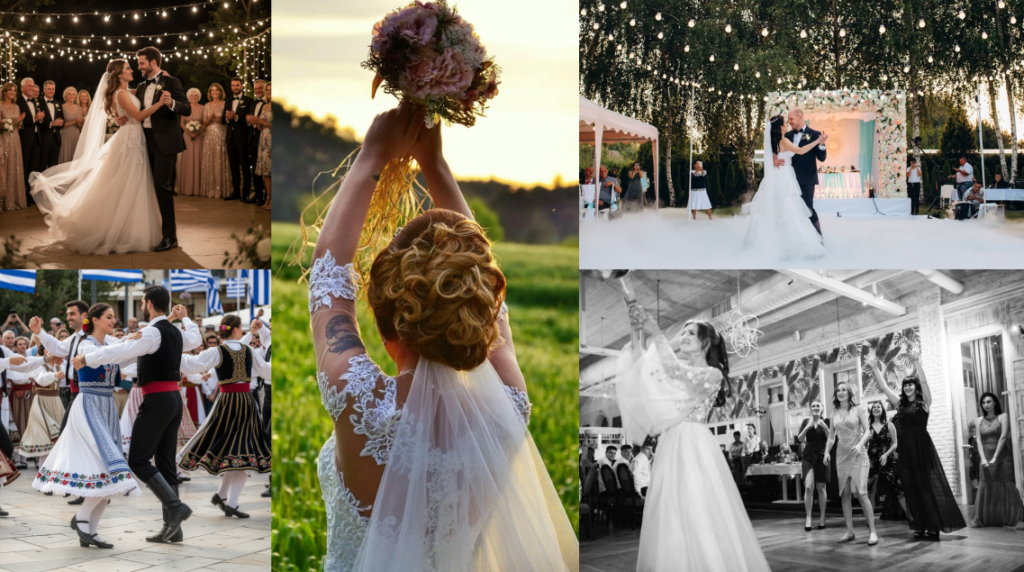
14. Tossing the Bridal Bouquet: The joyful tradition of tossing the bridal bouquet is also embraced in Greece. At the reception, the bride turns her back to a group of unmarried women and tosses her bouquet into the crowd. The lucky woman who catches it is believed to be the next to marry. It is a lighthearted and celebratory moment, filled with laughter, anticipation, and playful competition, symbolizing the continuation of love stories yet to unfold.
15. Wedding Dances – The Heartbeat of a Greek Celebration: There is simply no Greek wedding without music and dancing. As soon as the reception begins, guests gather in large circles, holding hands and dancing together, a beautiful expression of unity and shared joy. Traditional dances such as the sirtaki (made famous by Zorba), zeibekiko, and regional folk dances from the bride’s and groom’s hometowns bring generations together on the dance floor.
The groom may perform a passionate zeibekiko, a powerful solo dance expressing emotion and pride, while lively circle dances invite everyone, young and old, to join. Of course, modern Greek weddings blend tradition with contemporary flair. From folk instruments and island violins to r&b, pop, and international hits, the celebration evolves through the night, but the energy never fades. In Greece, weddings are not simply attended. They are felt, danced, and lived.
16. Flower Girls & Pageboys – The “Paranifakia”: In Greece, flower girls and pageboys, lovingly called paranifakia, hold a uniquely special role. Unlike in many countries where bridesmaids and groomsmen are adult friends, Greek brides are traditionally accompanied by young children. Their innocence symbolizes purity, fertility, and the blessing of future family life.
Dressed in outfits that echo the colors and style of the bride and groom, these little attendants walk beside the bride, helping her ascend the church steps and glide gracefully down the aisle. They carefully lift her veil and gown, ensuring every step is picture-perfect. Often seen as miniature reflections of the couple themselves, the paranifakia bring tenderness, charm, and heartfelt sweetness to the ceremony. Their presence adds a magical, almost fairy-tale quality, a gentle reminder that love is both sacred and beautifully simple.

A destination wedding in Greece is not only about the setting — though the sunsets, island chapels, and crystal waters are undeniably magical. It is also about becoming part of a tradition that has celebrated love for generations.
By embracing authentic Greek wedding customs, you invite symbolism, beauty, and heartfelt meaning into your special day. You allow your wedding to become more than a ceremony; it becomes a cultural journey, a shared celebration, and a timeless memory for everyone present.
In Greece, love is crowned, blessed, danced, and celebrated with the whole heart. And when you choose to say “I do” here, you don’t just begin a marriage, you begin your own Greek love story.
For more inspiration on Destinations Weddings in Greece, here is our Tie the Knot in Greece: Unveiling the Charm of Destination Weddings article.
*For an opulent experience in Greece, we invite you to explore our agency’s website. Allow us to curate the perfect journey tailored to your unique preferences and desires.


